



.webp)
5G Tower Lightning Risk : Why Your Coaxial Line Needs Protection
June 26, 2026

India's 5G Rollout Is Moving Fast But So Is the Risk
India crossed 4.5 lakh 5G base stations in 2024, and the number keeps climbing. Towers are going up on rooftops in Chandigarh's Industrial Area, on open plots across Punjab and Haryana, and in every urban pocket where telecom operators are racing to fill coverage gaps.
Each of these towers has one thing in common a coaxial cable running from the antenna at the top of the mast down to the Radio Base Station (RBS) or BTS equipment at the bottom.
That cable is doing a critical job: carrying the RF signal. But in a lightning event, it does something far more dangerous it becomes a conductor for surge current.
This is not a theoretical problem. It is one of the most common causes of base station equipment failure across India, particularly during the monsoon season.
If you operate telecom towers, manage ISP infrastructure, or are an EPC contractor deploying 5G sites this guide is for you.
How Lightning Actually Damages a Base Station
Let us be clear about physics, because understanding it helps you make better decisions.
When lightning strikes near a tower or even a kilometre away it creates an electromagnetic pulse and a sudden rise in earth potential. The coaxial cable's outer shield, which runs from the mast down to the BTS, acts as a path for that surge current to travel.
The surge races along the coaxial shield and enters the base station through the antenna port. What it finds there are sensitive RF transceivers, amplifiers, duplexers, and power supply units all of which can be destroyed or degraded in milliseconds.
The damage is not always immediate and catastrophic. Sometimes it shows up as gradual signal degradation, increased noise floor, or intermittent faults all of which are expensive and difficult to diagnose without the right test equipment.
The root cause, in most cases, was a surge event that nobody protected against.
The 5G Problem Is Bigger Than 4G - Here Is Why
Earlier 2G and 3G networks worked on frequency bands below 2.1 GHz. Most legacy coaxial surge protectors were designed for that range, and they worked reasonably well.
5G changed the equation. New 5G NR bands in India include:
- Sub-6 GHz bands — n78 (3.5 GHz), n77, n28, n40
- Millimetre wave (mmWave) — 26 GHz and above (still being deployed in select urban zones)
This means your coaxial surge protector must support frequencies up to at least 3.5 GHz, and ideally up to 7 GHz if you are future-proofing your installation or working with wideband antenna systems.
A protector rated only up to 1 GHz or 2.5 GHz will block or attenuate your 5G RF signal defeating the entire purpose of the installation. Insertion loss on the RF path must remain below 0.5 dB across the entire operating frequency range, otherwise you are degrading your link budget and reducing coverage.
This is a technical requirement that many generic surge protectors in the market simply fail to meet.
Where Exactly Should Surge Protectors Be Installed?
This is the question that causes the most confusion on site. The answer is: at both ends of the coaxial run and here is why.
At the mast / antenna feed point (top of tower) :
The protector here intercepts the surge before it enters the cable. It diverts the energy to the tower's earthing system. This is the first line of defence.
At the base station entry point (equipment room / shelter) :
Even with a top-mounted protector, residual surge energy can travel down the cable. The second protector at the BTS entry provides a final barrier before the surge can reach your transceiver or amplifier hardware.
Think of it like a two-door entry system in a high-security building. Even if someone gets through the first door, the second door stops them from reaching the critical area.
Both installation points require a solid, low-impedance earth connection. A coaxial surge protector without a proper earthing path is not protecting anything it is just creating a false sense of security.
What to Look for in a Coaxial Surge Protector for 5G Sites
Not all surge protectors are equal. Here is what you need to verify before specifying or procuring one for a telecom installation:
Frequency range : Must cover DC to at least 3.5 GHz for current 5G deployments. DC to 7 GHz is the right specification for future-ready installations.
Discharge capacity (Imax) : Look for a minimum of 10 kA. For exposed mast-top locations or sites in high-isokeraunic zones like Punjab and Haryana, 20 kA Imax is the right benchmark.
Insertion loss : Must be less than 0.5 dB across the rated frequency range. Anything higher degrades your RF path.
Impedance : 50 ohms, matched to standard coaxial systems. Mismatch causes reflections and VSWR issues.
VSWR : Should be below 1.3:1 to ensure minimal reflected power.
Protection technology : Gas Discharge Tube (GDT) is the preferred technology for RF coaxial applications because of its low capacitance, which is critical for maintaining signal integrity at higher frequencies. GDT-based protectors also have a well-defined breakdown voltage and are field-replaceable.
IP rating : Any outdoor installation mast top, weatherproof enclosure, or exposed feeder entry needs at least IP66.
DC pass : Many antenna systems supply power to LNAs or active components via the coaxial cable (DC-over-coax). Your surge protector must support DC pass so it does not interrupt this function.
Operating temperature : Installations in northern India face temperatures from sub-zero in winter to 45°C+ in summer. The protector must be rated for that full range.
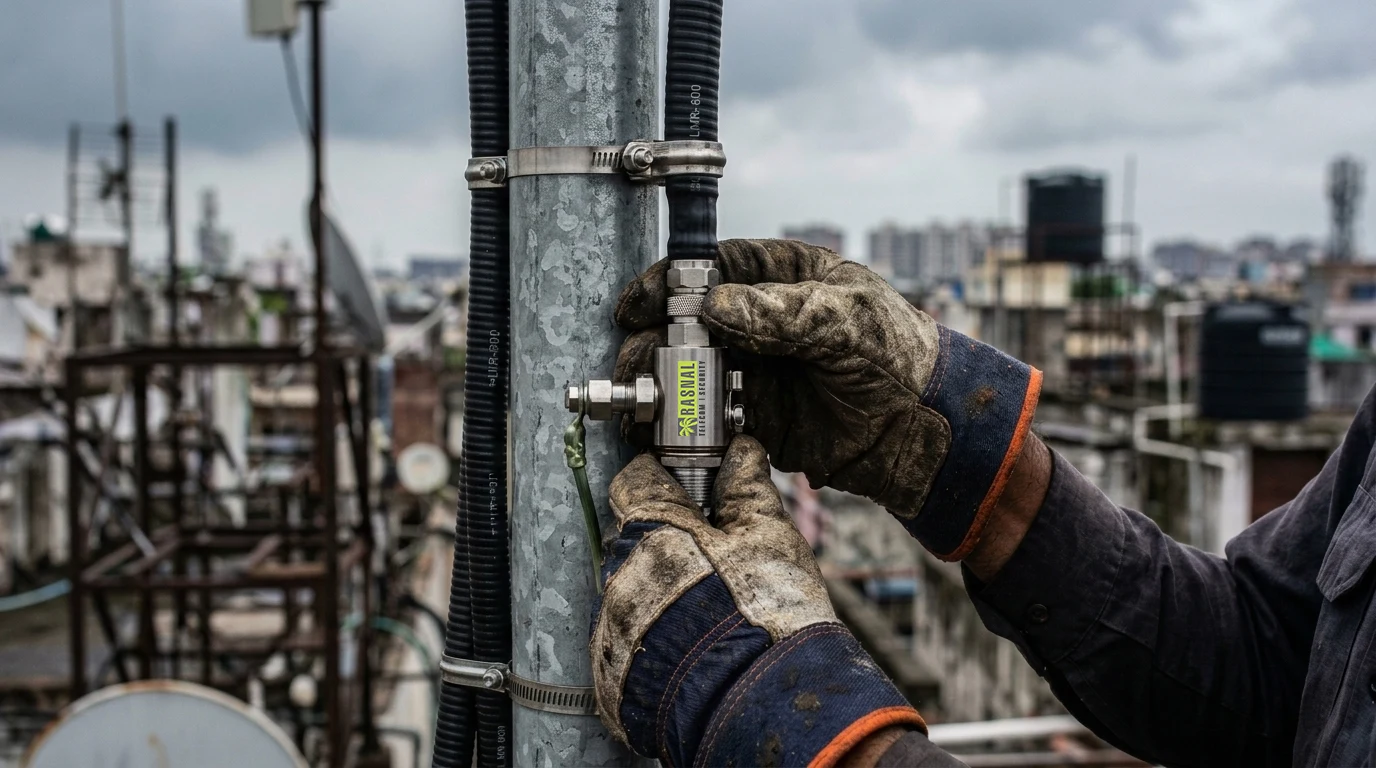
Rasnal's Coaxial Surge Protector - Built for Telecom-Grade Installations
Rasnal has been working with telecom infrastructure in India since 2003. The Coaxial Surge Protector from Rasnal is designed specifically around the requirements of real-world telecom and 5G installations.
The removable GDT design means maintenance is straightforward field teams can replace the protection element without disturbing the RF connector or cable termination, which reduces downtime and maintenance cost significantly.
Bi-directional protection handles surge energy arriving from either direction on the coaxial line, which matters on long antenna runs where induced surge can enter from the cable rather than the antenna port alone.
The product supports common grounding and equipotential bonding, which is the correct approach for any telecom site where multiple cables enter a shelter mixing unsynchronised earth potentials is itself a cause of equipment damage.
Who Needs This in Chandigarh and the Tricity Region
If you are in Chandigarh, Mohali, Panchkula, or the surrounding areas and you operate any of the following, coaxial surge protection is not optional:
- 5G and 4G base stations on rooftop or greenfield sites
- ISP wireless backhaul links using directional antennas
- CCTV and surveillance systems with RF video transmission
- Enterprise WiFi and point-to-point microwave links
- Broadcast and DAS antenna installations
- Solar monitoring systems with wireless data links
The Tricity region sees significant monsoon-season thunderstorm activity. Surge incidents during monsoon months account for a large share of annual telecom equipment damage across Punjab and Haryana.
How to Get Rasnal's Coaxial Surge Protector for Your Site
Getting the right coaxial surge protection in place is a straightforward process:
Step 1 — Site Assessment
Contact Rasnal's technical team with your site details frequency bands in use, cable run length, number of antenna ports, and existing earthing arrangement. The team will recommend the correct variant (DC–3.5 GHz or DC–7 GHz) and quantity.
Step 2 — Specification and Quotation
Rasnal provides a formal product specification and commercial quote suited to project procurement requirements including for EPC contractors who need documentation for client submission.
Step 3 — Procurement and Delivery
Chandigarh and Tricity deliveries are handled directly. Pan-India supply is available for large telecom rollout projects.
Step 4 — Installation Support
Rasnal's team can support installation guidance, earthing layout recommendations, and on-site consultation for complex multi-port antenna installations.
Step 5 — After-Sales and Maintenance
GDT replacement guidance, post-surge fault diagnosis, and product support are available through the Chandigarh office.
The Cost Argument - One Surge Event vs. Lifetime Protection
A single base station transceiver or RRU (Remote Radio Unit) can cost anywhere from ₹1.5 lakh to ₹10 lakh depending on the vendor and configuration. A coaxial surge protector even a quality telecom-grade unit costs a fraction of that.
The arithmetic is straightforward. One monsoon-season strike that damages an unprotected RRU costs more than a full set of properly specified surge protectors for the entire site, installed correctly with a good earthing system.
The real cost of not protecting is not just the hardware. It is the downtime, the SLA penalties, the field crew dispatch, and the reputational damage with the operator or enterprise customer who is expecting uptime.
5G is dense, fast, and increasingly deployed on exposed structures. Every coaxial cable on every one of those sites is a potential surge path during a lightning event. The solution is not complicated; it is a properly specified, correctly installed coaxial surge protector at both the antenna feed point and the base station entry, backed by a solid earthing system.
The specification has to match 5G frequencies. The discharge capacity has to match the site's exposure level. And the product has to be sourced from someone who understands telecom infrastructure not a generic electrical wholesaler.
Frequently Asked Question
Q1. What does a coaxial surge protector actually do for a 5G tower?
It intercepts surge current that travels along the coaxial cable's outer shield during a lightning strike and diverts it safely to earth before that current can reach and damage the base station equipment, transceivers, or amplifiers connected at the other end.
Q2. Do I need surge protectors at both ends of the coaxial cable?
Yes. Best practice for telecom installations is to fit a protector at the antenna feed point (top of mast) and a second one at the point where the cable enters the base station shelter. The top unit handles the majority of the surge; the bottom unit catches residual energy that gets through.
Q3. Why does the frequency range of the surge protector matter for 5G?
5G uses higher frequency bands up to 3.5 GHz for sub-6 GHz deployments in India. A protector that is only rated to 1 or 2 GHz will attenuate or block the 5G signal. You need a unit rated to DC–3.5 GHz at a minimum, and DC–7 GHz for future-ready installations.
Q4. How do I know if my base station has been damaged by a lightning surge?
Common signs include increased noise floor, dropped call rates higher than normal, intermittent faults on specific antenna ports, and unexplained VSWR alarms. Not all surge damage is instant partial degradation can go unnoticed until the equipment fails completely during the next surge event.
Q5. Where can I get a reliable lightning protection solution in Chandigarh for telecom use?
Rasnal Telecom & Security, based at Industrial Area Phase-2, Chandigarh, supplies telecom-grade coaxial surge protectors suitable for 5G, 4G, ISP, and enterprise antenna installations. You can contact them directly via rasnal.com for specifications, quotation, and site consultation.
Explore Categories
.webp)
Digital Grounding devices
Industrial & Network Solutions
Solar & Smart Energy
Fire Safety Systems
Surge Protection
CCTV & Security
Solar Energy